Findings

Main Results

We trace the response of exchange rates, equity returns and international capital flows to spikes in global climate attention (top‑15% CAI days). In every asset class, countries and firms that are more sensitive to climate news respond more — and the effect is persistent.

01 · Currencies

Climate-sensitive currencies appreciate

Sorting country pairs by their estimated exposure to the global CAI, the currency of the more climate‑sensitive country appreciates in the days following a climate‑attention shock, and the effect persists for multiple weeks rather than reverting immediately.
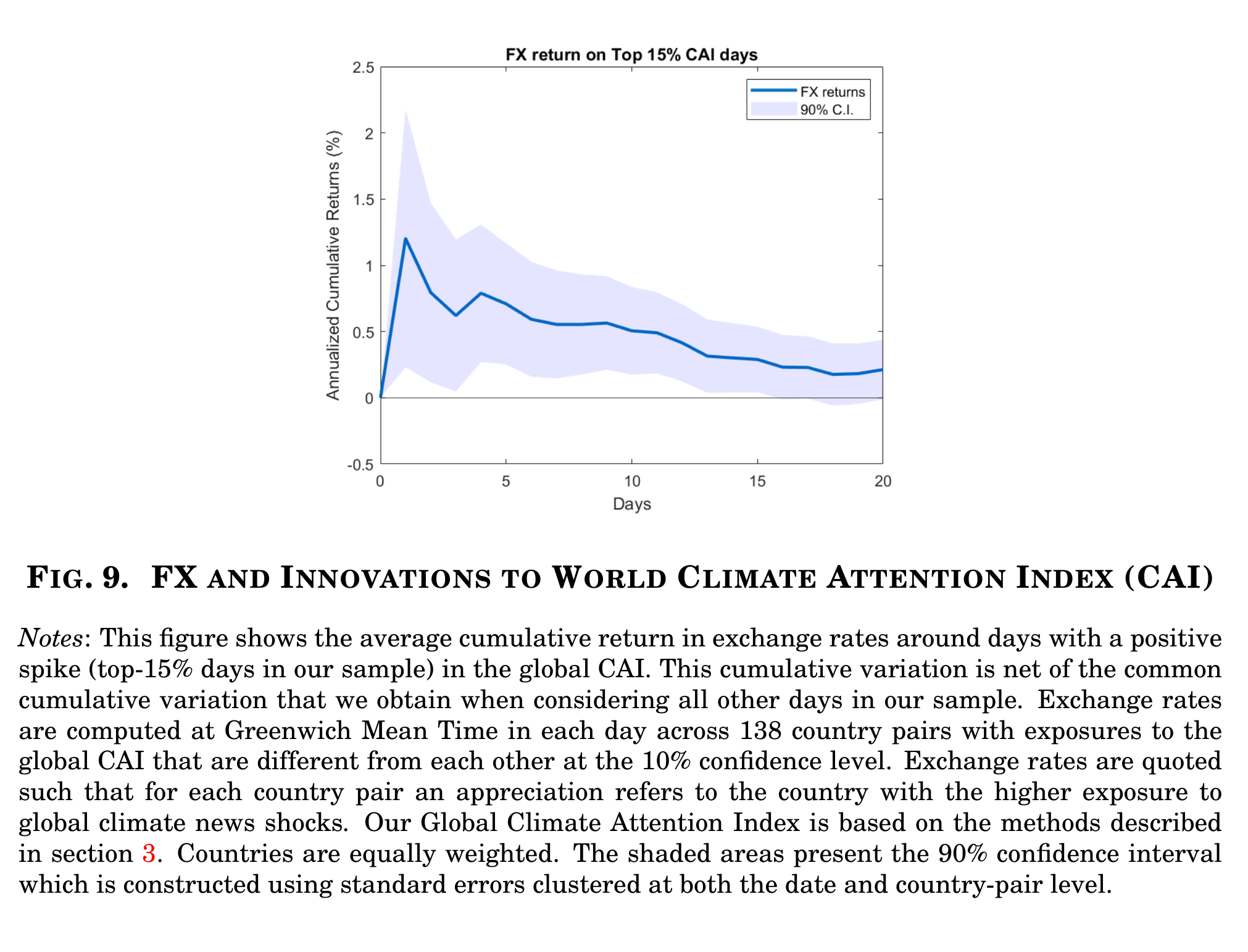
FX returns on top 15% CAI days, showing cumulative appreciation of the higher-exposure currency over 20 days
Figure 9

Average cumulative exchange-rate return in the days after a top‑15% spike in the global CAI, net of the average on all other days. Shaded band: 90% confidence interval.

Headline number

In a typical year, the currencies of high-exposure countries appreciate by roughly 1.25% on the day after a large climate-attention shock — an economically significant, and persistent, response.
02 · Equities

Brown stocks sell off in highly exposed countries

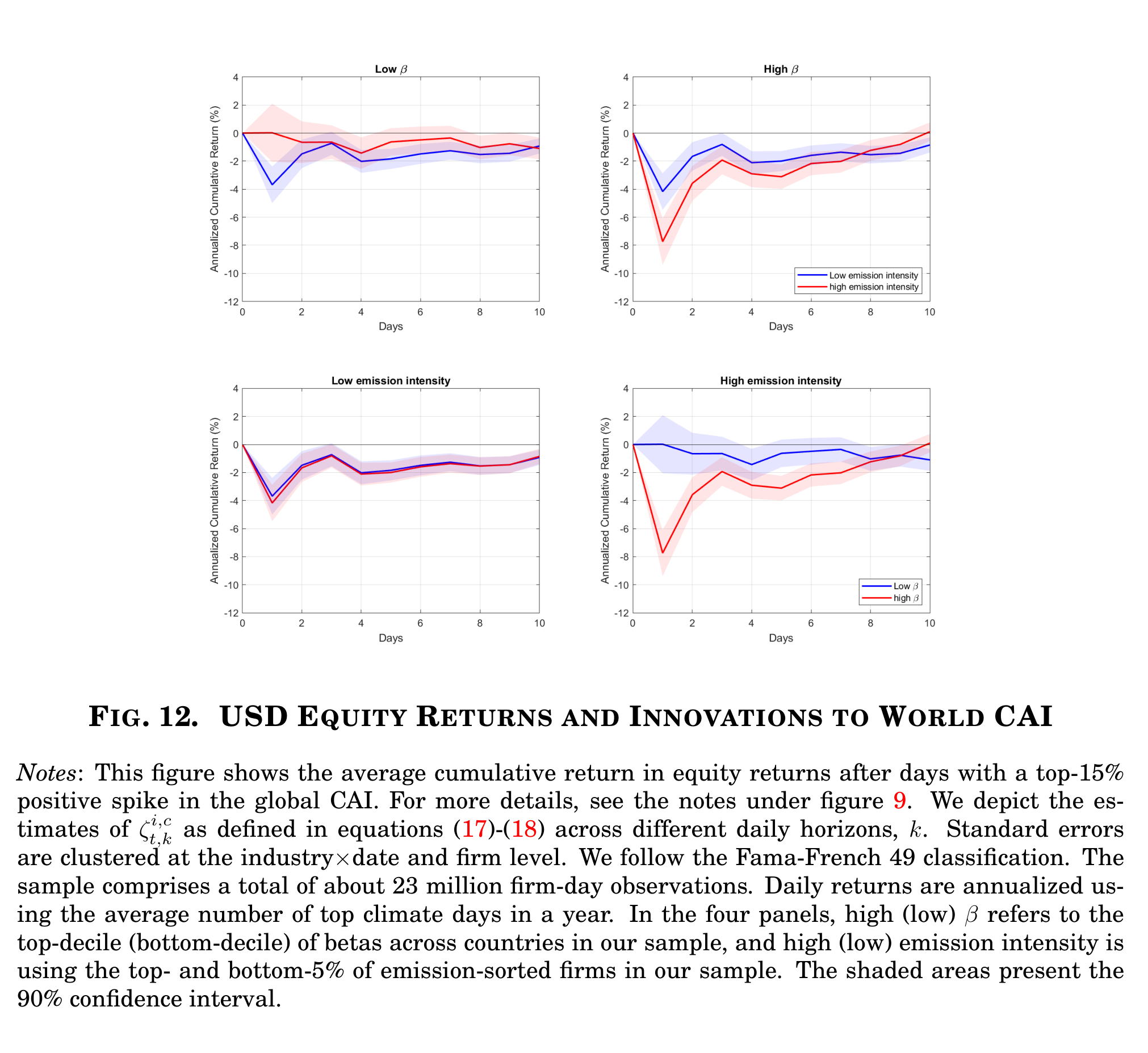
We sort firms by carbon emission intensity and by their headquarter country's exposure to global climate attention (β). High-emission ("brown") firms located in highly-exposed countries see the sharpest and most persistent losses; low-emission firms, and firms in low-exposure countries, show little reaction.

USD equity returns and innovations to the World CAI, sorted by country beta and firm emission intensity
Figure 12

Average cumulative equity return in the days after a top‑15% spike in the global CAI, by country climate-beta and firm emission intensity (Fama‑French 49 industries; ~23 million firm‑day observations).

Headline number

The annualized response of high-emission firms headquartered in high-β countries is roughly −8% — comparable in magnitude to other tweet-based asset-pricing evidence in the literature.

03 · Capital Flows

Current accounts adjust through risk-sharing

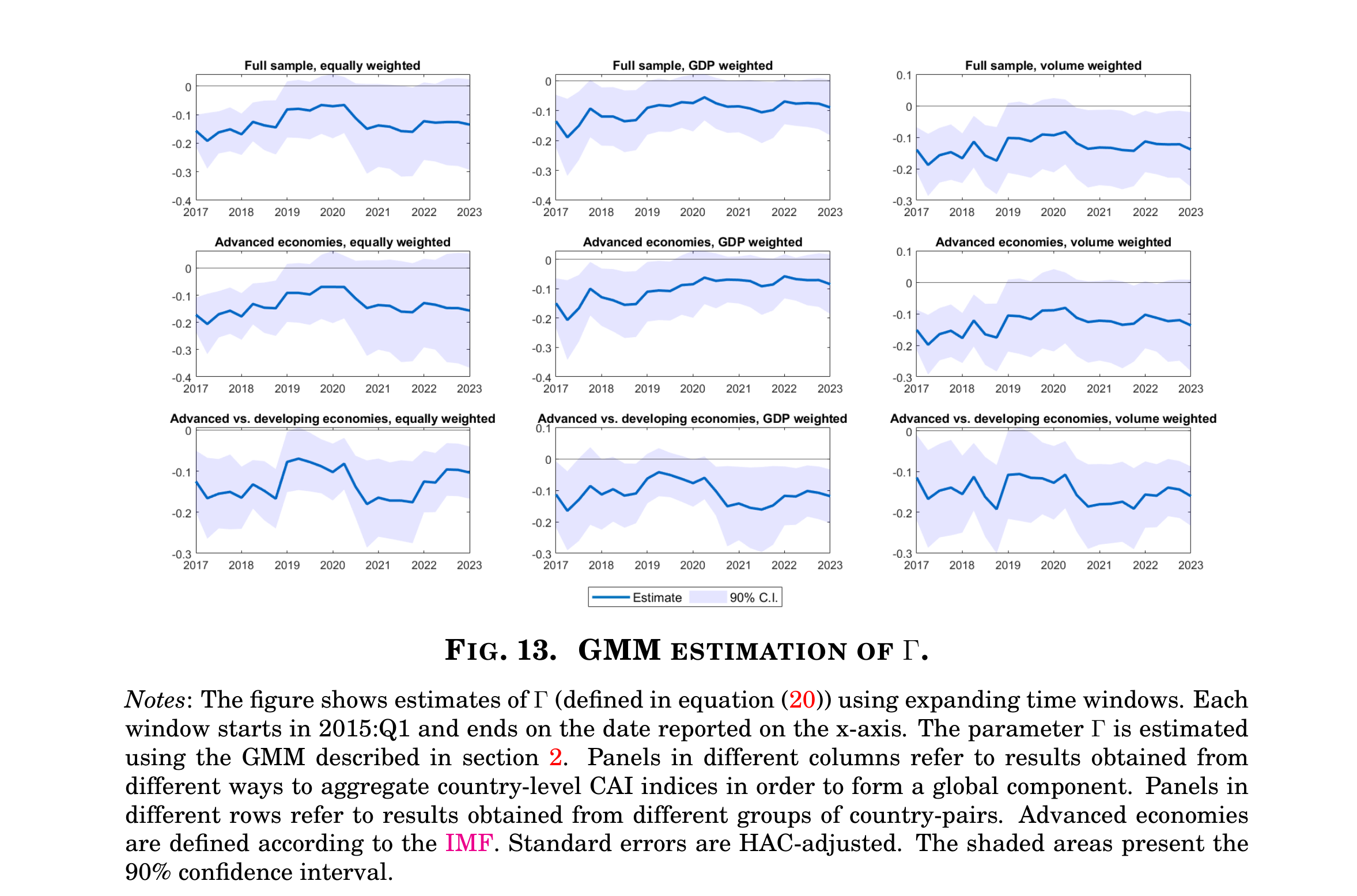
Countries with higher climate-attention sensitivity see their current account decline relative to less exposed partners as global climate attention rises — consistent with a recursive risk-sharing mechanism in which exposed countries receive resources (capital inflows) rather than exporting more. Estimated with an expanding-window GMM from 2015 onward, the negative relationship is stable across equally-weighted, GDP-weighted and Twitter-volume-weighted versions of the global index.

GMM estimation of the current-account response to global climate attention shocks, across weighting schemes and country groups
Figure 13

Expanding-window GMM estimates of Γ, the sensitivity of the net-export differential to the global CAI, by aggregation scheme (columns) and country grouping (rows). Shaded band: 90% confidence interval.

Headline number

The estimated coefficient is negative and stable across specifications, and the current-account effect can persist for up to six months.